How Often Should You Test Your Pool Water? Commercial Pool Owner Guide
Since swimmers introduce sweat, sunscreen, dirt, and microorganisms, commercial pool water doesn’t stay chemically still. Sunlight breaks down the chlorine, while rain dilutes chemicals and shifts pH. Feeder or circulation trouble will also change readings quickly.
If you skip regular water testing, low disinfectant levels are likely to go unnoticed. Poor pH control weakens chlorine performance, irritates swimmers, and contributes to corrosion and scale. Algae are known to create slippery surfaces and clog filtration systems. Meanwhile, too much sanitizer can damage covers, liners, metal parts, and pool equipment.
Pool water testing creates a paper trail for inspections. Regulations range across North Carolina, South Carolina, and Georgia, so operators need to follow their local requirements.
Key Water Chemistry Parameters: pH Levels, Calcium Hardness, Alkalinity
The right water chemistry comes from several readings working together. Finding a good balance extends pool life and preserves its appearance:
- pH: Target 7.2 to 7.8; the CDC recommendation is 7.0 to 7.8. High pH weakens chlorine and promotes scale, and low pH can irritate swimmers and corrode surfaces, plumbing, and equipment.
- Free chlorine: The CDC recommends at least 1 ppm without cyanuric acid and at least 2 ppm when used. 1 to 4 ppm working range will fit some facilities, but code and product labels control that. Test the pool water before adding chlorine.
- Total alkalinity: Alkalinity defends against sudden pH swings. Georgia allows 60 to 180 ppm, with ideal ranges depending on the disinfectant. Check weekly, as levels below 80 ppm can make pH unstable and raise corrosion risk.
- Calcium hardness: Low calcium etches plaster, grout, and concrete; high calcium can cause cloudy pool water, scale, clogged filters, and heater inefficiency. Georgia lists 200 to 400 ppm as ideal. Test calcium hardness on a monthly basis.
- Cyanuric acid: Outdoor pools use it to protect chlorine from sunlight. Test monthly or as often as local rules require. Georgia requires checks every two weeks when stabilized chlorine is the main disinfectant.
Recommended Water Testing Frequency for Commercial Swimming Pool Facilities
How often should you test your pool water in commercial settings? Start with the schedule below, then tailor it to your local code, bather load, weather, and performance requirements:
- Hourly during peak use: Check disinfectant and pH when crowds build or when a large event is underway.
- At least twice daily during normal operation: This is the CDC baseline for disinfectant and pH. Georgia also requires two checks during operating hours.
- Daily at minimum: South Carolina requires daily readings or more frequently if needed. North Carolina requires daily disinfectant and pH records.
- Once a week: Test the total alkalinity. Once-weekly water testing is too infrequent for an open commercial facility.
- After a storm, contamination, or heavy use: Test the pool water immediately. Rapid changes can require closure and a documented response.
Once-a-Week Testing and Daily Pool Water Checks
Daily rounds should address disinfectant, pH, water clarity, temperature for heated venues, water level, flow, filter pressure, and signs of contamination. Also check the chemical feeders, controller alerts, pumps, drains, and accessible tubing for leaks.
Once weekly, test total alkalinity and other parameters required by code or the treatment system. Review combined chlorine, cyanuric acid, filter condition, chemical inventory, and log trends. Make sure to stay on top of maintenance tasks, such as filter cleaning or backwashing.
Intensify your testing measures when readings approach limits, traffic rises, rain enters the pool, or water turns cloudy. After making a correction, test the water again.
Water Testing Methods and Pool Automation
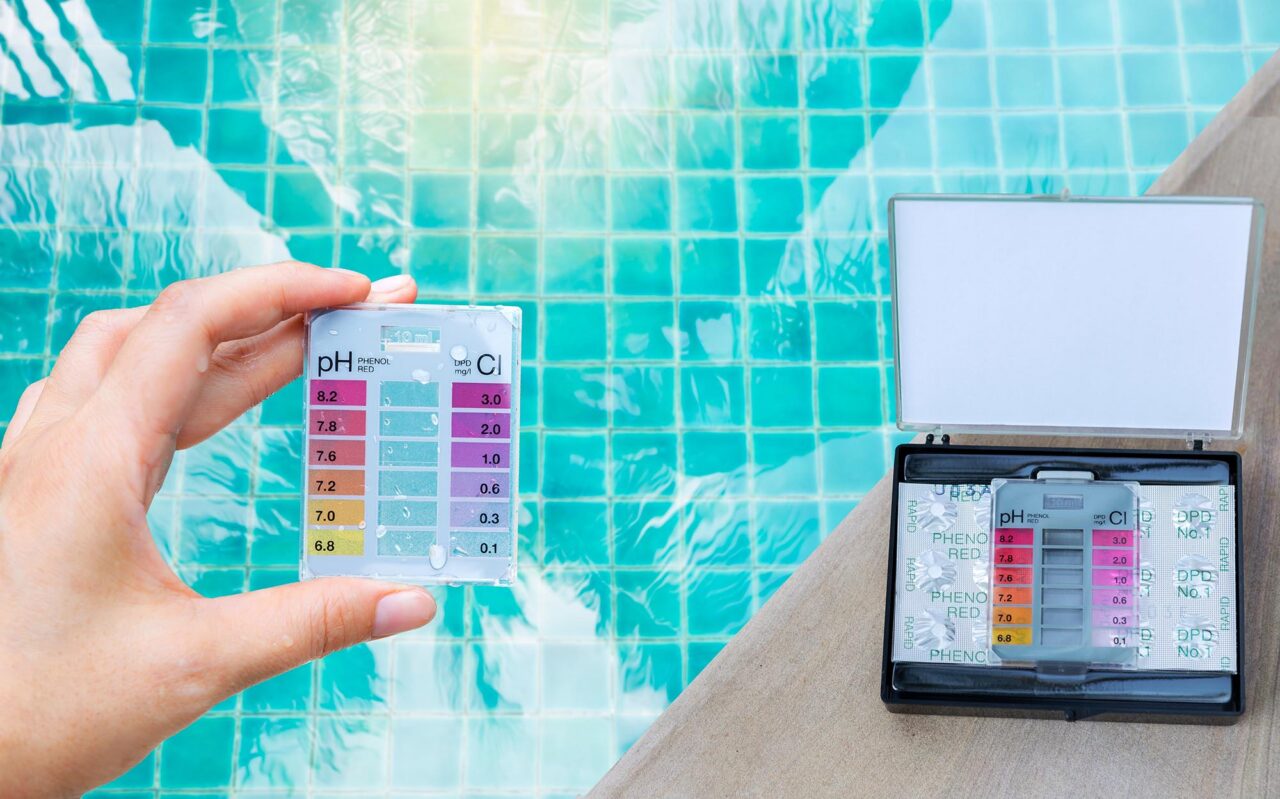
Test strips are a convenient screening tool, although color matching is subjective; the CDC considers them to be less accurate than DPD test kits. Titration kits use a small pool water sample and measured reagents for more precise results.
Handheld photometers can read color responses electronically. This reduces interpretation errors, but clean cells, fresh reagents, technique, and calibration still need to be prioritized.
Large facilities can use continuous sensors and automated controllers to track pH and oxidation-reduction potential, trigger alarms, and control feeders. However, automation doesn’t replace physical water testing; compare all sensor readings with poolside samples and calibrate as directed.
Combining results, corrective actions, and chemical additions makes trends much simpler to spot.
Troubleshooting Cloudy Water and Water Chemistry Upsets
Cloudy pool water can be caused by low disinfectant levels, high pH, algae, poor circulation, filter trouble, or calcium scale. Here’s how to find out:
- Close the pool if the main drain isn’t clearly visible or if readings fall outside required limits.
- Test pH and free chlorine right away, then check combined chlorine, alkalinity, and calcium hardness.
- Inspect circulation, skimmers, pump baskets, returns, flow, and filter pressure.
- Backwash or clean the filter when manufacturer instructions call for it.
- Correct the likely cause, circulate the water, and test before reopening.
Guesswork with chemicals can waste product and create another imbalance. On the other hand, a clear diagnosis protects water chemistry and keeps downtime to a minimum.
Typical Commercial Pool Testing Schedule
Hourly during peak periods
- Record free chlorine or bromine and pH.
- Confirm water clarity and main-drain visibility.
- Review the controller readings, alarms, flow, and feeder operation.
- Note the swimmer load, weather changes, and corrective actions.
Daily
- Test disinfectant and pH at opening and at least once later on.
- Check the temperature, water level, filter pressure, circulation, and visible conditions.
- Inspect all safety items, chemical systems, and pool equipment.
- Log numerical readings, times, initials, chemicals added, and follow-up results.
Once a week
- Test the total alkalinity.
- Review combined chlorine and cyanuric acid based on local rules and system type.
- Rotate the sample locations, making sure to include the deepest area.
- Track trends and complete scheduled maintenance tasks.
Monthly
- Test calcium hardness and cyanuric acid, if applicable.
- Review saturation index, chemical use, sensor calibration, and recurring alerts.
- Arrange a professional water chemistry assessment to uncover trends.
Recordkeeping, Compliance, and Training for Swimming Pool Staff
Maintain records for as long as your local authority requires. North Carolina calls for operating records to remain onsite for at least six months, and South Carolina requires the previous 18 months of reports to be available at the facility. Georgia demands daily records, including test results and corrective actions.
Entries detail the date, time, numerical result, tester, chemical additions, equipment observations, and action taken. Digital logging tools increase legibility, flag missed checks, and streamline reviews, but they still need to adhere to local requirements.
Staff training should cover sample collection, test-kit use, chemical labels, protective equipment, spill response, contamination procedures, and closure limits. Don’t overlook everyday mistakes like expired reagents, dirty cells, incorrect sample depth, and dosing before testing.
When to Engage Aqua Management Partners for Water Chemistry Support
Professional support makes sense when chemistry continues to drift, cloudy water keeps coming back, sensors don’t match with manual results, or an incident threatens operation.
Aqua Management Partners crafts customized plans across the Carolinas and Georgia. Our services include testing, water balancing, equipment inspections, automation, training, diagnostics, repairs, and documentation.
Facilities can schedule chemical-management audits or call us during an urgent water-quality event. Contact Aqua Management Partners to discuss your pool’s needs today.
Frequently Asked Questions
What Immediate Action Should Staff Take After a Failed Reading?
Close the pool when required, verify results, inspect the system, make a measured correction, document it, and test again before reopening. For biological contamination, follow the facility’s response plan and the latest guidance from applicable health authorities.
Why is My Pool Losing Two Inches of Water a Day?
Two or more inches per day strongly suggests a leak or overflow problem. Check the fill and overflow systems, run a 24-hour bucket test, and arrange leak detection if the pool loses more water than the bucket.
How Long Can You Keep the Same Water in a Pool?
There’s no exact expiration date; proper filtration, disinfection, dilution, and balance keep pool water usable for years. EPA guidance says a well-maintained pool might need a full drain only every three to seven years, though partial replacements could be needed sooner.
What Happens if You Don’t Test Your Pool Water?
You could miss spotting low sanitizer levels, harmful pH, algae, cloudiness, scale, or corrosion. Those can all raise illness risk, damage equipment, waste chemicals, cause failed inspections, or even force closures.
How Long Does Pool Water Last for Testing?
Test a poolside sample immediately; chlorine can dissipate, while air exposure may affect pH. Old samples won’t reliably represent the swimming pool, so collect fresh pool water if testing gets delayed for any reason.
